The hall
The 1837 Strauss Hall
The history of the hall in Döbling: the Casino Zögernitz of 1837, the Strausses who played there, its decline and its restoration, with sources.
Check the concert dates ↗Quick answer
The hall opened in 1837 as part of the Casino Zögernitz, a social venue in Döbling built in the Biedermeier style. A plaque records Johann Strauss at the opening, and later the family played there. After decline, the hall was listed as a monument in 2008 and restored, and now hosts the House of Strauss concerts.
Opening in 1837
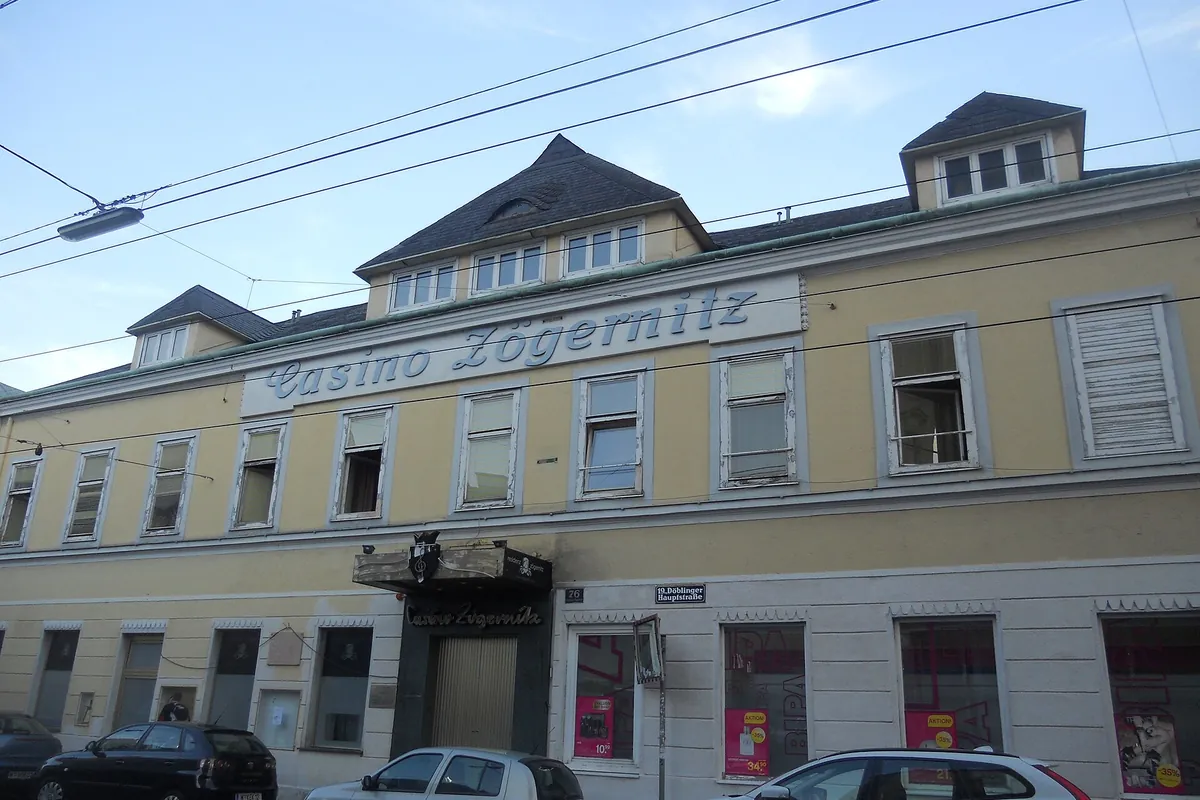
The House of Strauss's history page says the Viennese citizen Ferdinand Zögernitz had a Biedermeier-style residence built on former imperial property, and that the Casino Zögernitz opened in 1837. With its richly decorated hall and a beautiful garden it became a popular meeting place for the best of Viennese society. Wikipedia describes the Biedermeier period as running from 1815 to 1848, an era when a growing middle class became a new audience for the arts, so the hall belongs to a time when public dance and concert rooms were new.
The plaque of 1927
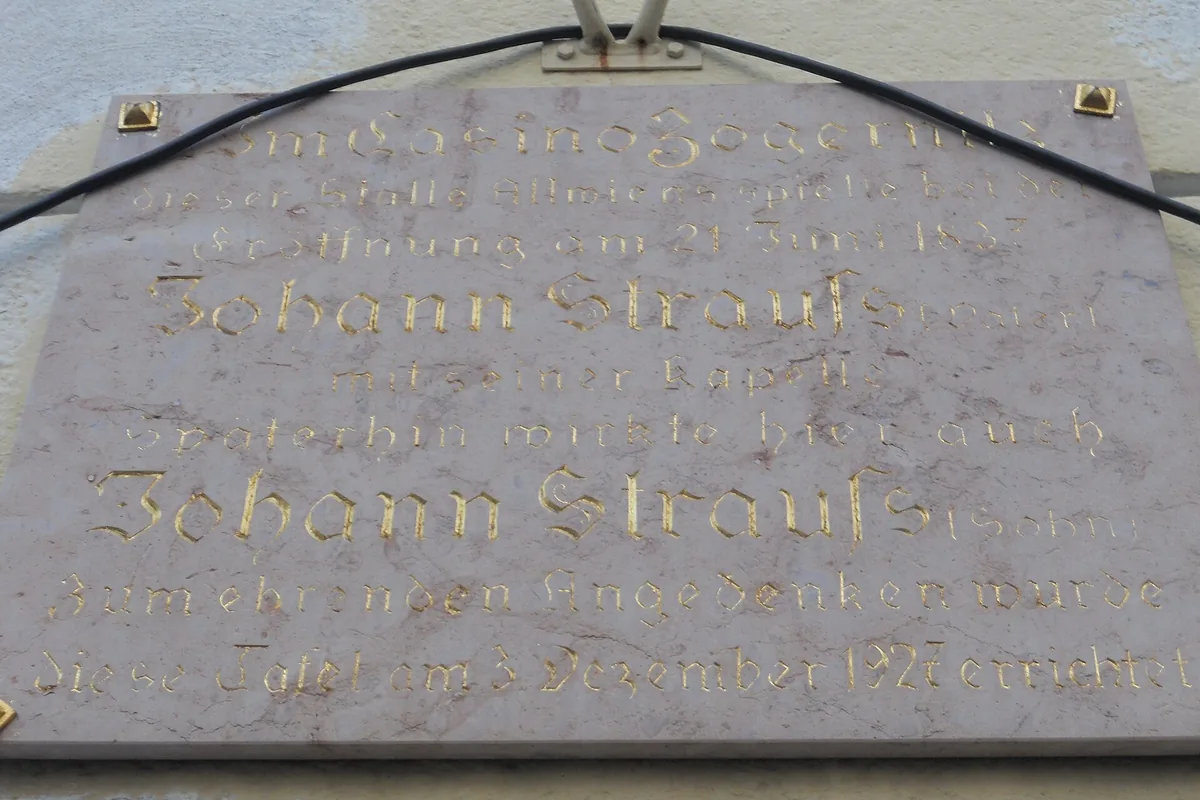
A marble plaque on the façade carries gold lettering. As the inscription reads in German, it says that Johann Strauss played with his orchestra at the opening of the casino on 21 June 1837, and that Johann Strauss the son worked there later. It also says the plaque was put up in memory on 3 December 1927. It is a memorial put up ninety years after the opening, not a contemporary record, but it is on the street and free to read whether or not you hold a ticket.
1850, a festival for his benefit
The history page says that in the summer of 1850 Johann Strauss organised a large Viennese folk festival at the casino for his own benefit, with a ball, illumination and fireworks. For the ball the young Strauss promised a new waltz as an attraction, titled Johannis-Käferln. The page notes that this is the Viennese word for fireflies, which can often be seen on summer nights, especially in the Döbling area.
From 1880, concerts and a tram terminus
The history page says that from 1880 the Strauss Hall was also the venue for numerous concerts by the brothers Johann and Eduard Strauss, and by the house bandmaster Fahrbach. It adds that from 1870 to 1903 the terminus and depot of the horse-drawn tramway stood on the site of the dining garden, and that the terminus moved to the Hohe Warte when the tramway was electrified. For more than three decades the casino stood beside the end of a tram line.
The twentieth century
In 1913 the restaurateurs Alfred and Maria Stegbauer took over the casino and, from 1920, ran an open-air cinema in the garden. They built a new building in 1926 in a modernised old-Viennese style. After 1945 the casino was revived, with the Viennese carnival, balls, small dances, summer parties and theatre and opera performances. Major recordings of early and classical music have been made in the Strauss Hall since 1967, and the history page says Nikolaus Harnoncourt played there with his Concentus Musicus.
Decline and rescue
The casino passed to the Archdiocese of Vienna in a bequest, and by 2007 the history page says the old building was in poor condition and had stood vacant for years. It was listed as a historical monument in February 2008, and in the same year a developer bought the property and planned to pay for its revival by building new apartments on the derelict site. A restoration in close coordination with the Federal Monuments Office began in 2017, and by 2022 the original wall paintings of the hall were being restored.
What you sit in today
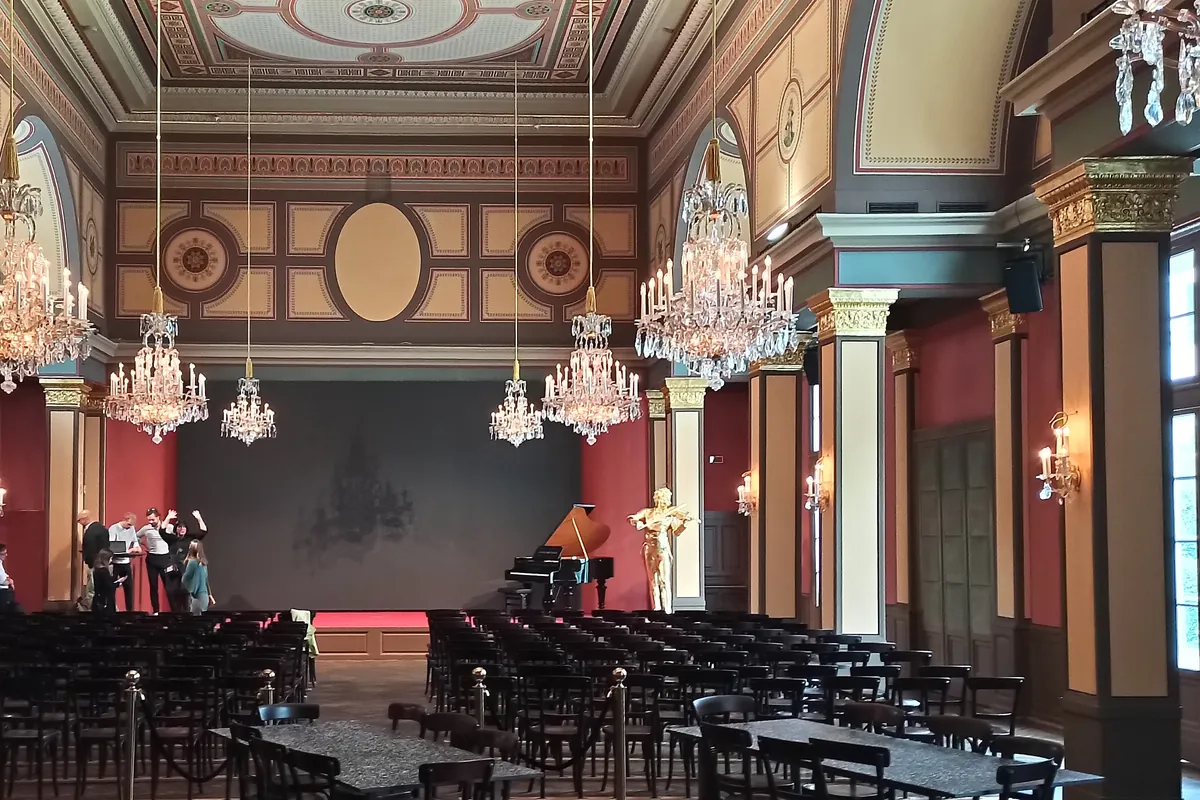
The restored hall has painted walls, crystal chandeliers and rows of bentwood chairs. The booking page describes reserved seating on historic Thonet chairs which it calls original 19th-century ones, and the House of Strauss's concerts page mentions surround sound and a light show. Photographs of the hall were taken on Austria's Heritage Day in 2023. Treat the old history and the new staging as two layers: the room is from 1837, and the film, lighting and sound are modern additions around it.
The claim that all four performed here
The House of Strauss calls the hall the last remaining original venue where all four Strauss composers performed. The plaque names Johann Strauss at the opening and his son later, and the history page names Johann II in 1850 and Johann and Eduard from 1880. None of the sources cited here names Josef at the hall, so read the claim of all four as the venue's own. It does not change what you hear in the concert, but it is worth knowing which part of the story is documented in the sources and which part is the venue's own account.
Read next: House of Strauss: worth it?
Frequently asked questions
When did the hall open?
In 1837, as part of the Casino Zögernitz, according to the House of Strauss's history page and the plaque on the façade.
Is the hall restored?
Yes. It was listed as a historical monument in 2008, and a restoration in coordination with the Federal Monuments Office began in 2017. By 2022 the original wall paintings were being restored.
Did all four Strauss composers play there?
The House of Strauss says so. The plaque and the history page name Johann I, Johann II and Eduard, and none of the sources cited names Josef at the hall.
Sources